Born Again (and Again)
In hindsight, I was the perfect candidate to join a cult.
Young. Ambitious. Spiritually open. Sexually repressed. Hungry to find my calling in life. If I saw Tyler Durden punching himself in a dimly lit parking lot, I probably would have joined his club.
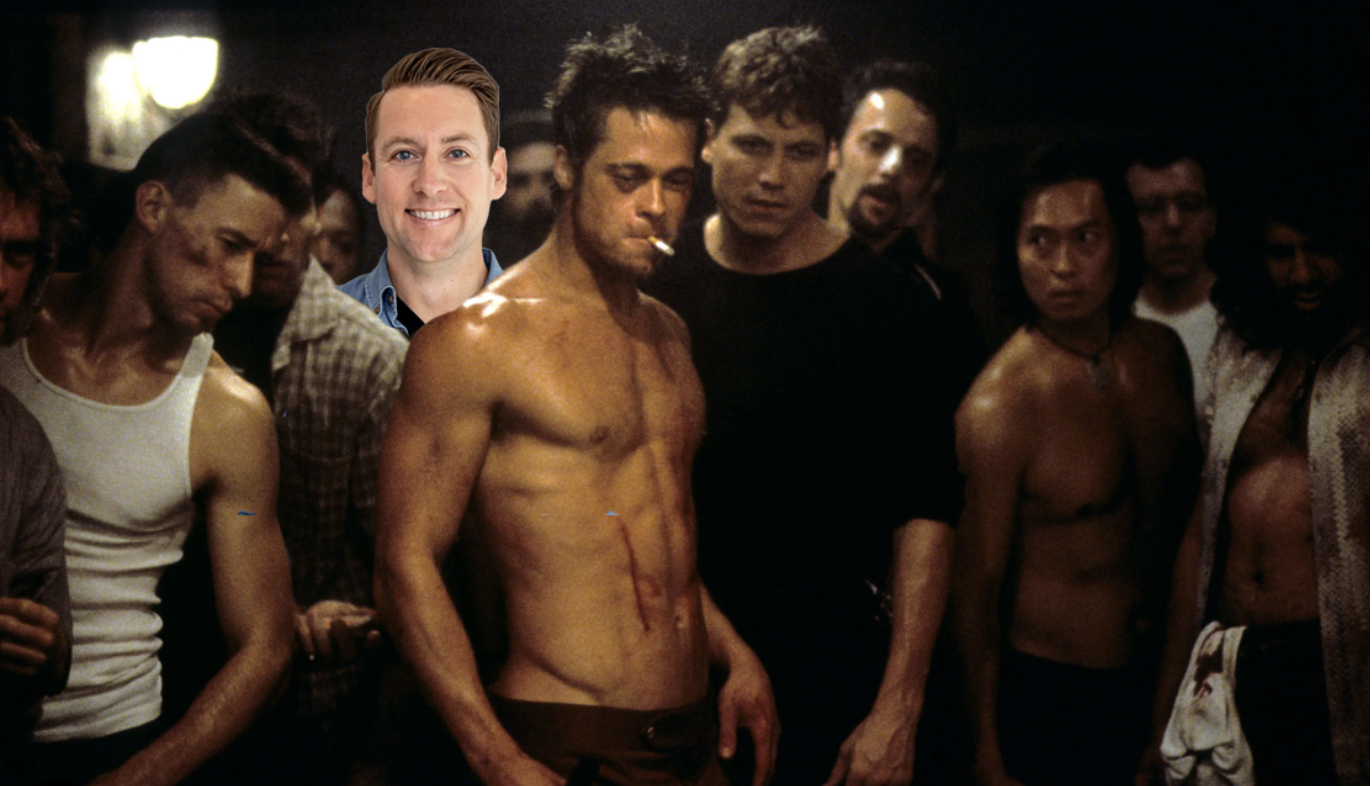
But instead, the church recruited me. And I still managed to get my ass kicked somehow.
Specifically, it was a church in the Acts 29 Network, the quasi-denomination built by young, restless alpha males with the spirit of Gen X rebellion and hip Millennial tastes. Basically, dude-bros who rejected Ned Flanders’ dorky vibe but kept his conservative beliefs (and added a bunch more).
These ministry entrepreneurs channeled the testosterone-fueled energy of Fight Club to create a distinct flavor of masculine Christianity, branded with flannel and skinny jeans, and they planted churches in urban centers teeming with zealous young evangelicals. I was invited to one of these churches. I checked it out, checked it out again, and started volunteering.
Then I was consumed.
You might think I’m being dramatic in calling this church a cult. Fair enough. But it’s at least a diet cult. We’re talking about a rigidly hierarchical organization that called itself a family, clearly defined insiders and outsiders, had leaders who claimed to hear directly from God, and rallied thousands of proselytes on a divine mission to convert the globe. This church shaped every one of my beliefs, values, and motivations. It was my primary social group and set the path for my family and my career. It even affected my personality and physical health. I like to think that I would have been able to avoid drinking cyanide Kool-Aid, but I’m glad I didn’t face that decision.
The technical term for diet cult is “high control religion” (HCR). HCRs aren’t exactly going to get in a shootout with the ATF, but they’re definitely not casual faith communities either. They’re religious systems that shape thoughts and actions through spiritual authority, conforming members into a distinct mold through coercion and fear.
HCRs claim to be governed by God, but they’re also governed by ambitious empire builders with a lust for power and fame who will discard anyone who gets in their way. Popular American HCRs include The Church of Jesus Christ of Latter-day Saints, Jehovah’s Witnesses, and Scientology, but there are many versions of Christianity, including Acts 29, that give you that same great diet cult taste.
How did I get sucked into my HCR? Easy. I was born for it.
Born to Born-Agains
If you can imagine an idyllic evangelical household, that’s pretty much what I was raised in. I had a wholesome and loving nuclear family who wore matching outfits for our yearly portrait, and I’d often come home from school to the sweet aroma of caramel apples. Yet I still found shit to complain about.
My biggest gripe was going to church. We attended every Sunday, and I utterly despised it. Sometimes I would feign sickness, which never worked. Other times, out of protest, I’d lie in bed as long as I could, like John Lennon and Yoko Ono famously did. Their goal was world peace. Mine was just to make us late for service in the hopes that my parents would reevaluate their religious commitments. That never worked, either. Nothing could stop the fate of church attendance.
Since I was there against my will, I would try to participate as little as I could. I’d sit in the back, half-ass the crafts, not listen to whatever the leader was teaching—pretty much just passive rebellion. I was too lazy to employ any other tactics. But I absorbed enough of the Sunday School material to develop a general framework for understanding life. I can outline it like this:
God created everything in six literal days. The world was perfect.
Then the first two humans, Adam and Eve, ate naughty fruit because a demon snake told them to.
Sin entered the world, and we’re all infected by it. This is why death, war, and the Los Angeles Dodgers exist.
Abraham did stuff. Moses did, too. Oh yeah, David’s a king! And Jonah was swallowed by a whale. Anyway, who cares?
Jesus was born. Reenacting this event was a cornerstone of my preschool education.
Jesus did miracles. He also taught us not to do fun things, like watch R-rated movies.
Jesus died on the cross, which paid for our sins somehow.
Those who believe in him will go to heaven. It’s vague, but nice. And we could get beamed up there at any moment.
Those who don’t believe in Jesus, however, will be banished to a cauldron of fire, grinding their teeth to the gums as they wail for mercy, which never comes, ever, because they are destined for excruciating torment on loop forever.
In the meantime, we go to church to be reminded of the points above. Anyway, who cares?
Even though I loathed church, I was terrified of hell. One time, at the age of 11, I was sitting on the toilet and started thinking about the frightening future. The concept of eternal conscious torment got me so worked up that I started passing out, so I feverishly prayed for the thousandth time in my young life that Jesus would save me. (In calmer, more rational times, I assumed I was going to get raptured.) The fear of damnation oddly prompted me to live for the moment, so I swore to myself while sitting on that porcelain judgment seat that I would ask my crush to be my girlfriend. The next day, I worked up the courage and did. She said no.
Aside from occasionally begging for eternal life, I wasn’t very spiritual in my youth. I’d pray sometimes, usually asking God to help me hit a home run before it was my turn to bat in Little League. Then I’d get angry with him when I didn’t, which was always, because I was pretty scrawny and couldn’t hit a ball past the warning track without a miraculous jet stream.
For supplementary indoctrination, I was occasionally dropped off at a youth program at my church called Awana, which, if you’re not familiar, was a silly mashup of Native American cultural appropriation and Girl Scouts with mini-sporting events sprinkled in to entice the boys. The catch was that we would have to take a break from the competitions to learn about the Bible. However, they’d incentivize us to memorize verses by offering Awana Bucks as a reward, which could be redeemed for cheap trinkets. So on a weekly basis, I’d hastily memorize something like “THE WAGES OF SIN IS DEATH”, recite it, forget it, and take the fake cash I earned to buy a balsa wood airplane that would break on the first throw. Then I would turn my focus towards beating homeschoolers in a race to grab a bowling pin. That was the part that enticed me, just as the Awana masterminds designed.
What I especially despised about my evangelical upbringing was being sheltered from secular media. The Baby Boomer evangelicals who rejected the counterculture of the 60s/70s took it one step further by making sure their Millennial kids rejected all culture. My private kindergarten even banned Care Bears because “magic is demonic”, even if the demon-vessel happens to live in a place called Care-a-Lot and has a heart embroidered on its chest. (My school shut down after that year, so I was fortunate to move on to public education, which was far less worried about the spiritual dangers of whimsical animated creatures.)
To fill the void of secular culture, we had evangelical knockoffs of everything. Our music mimicked its secular counterparts in every way except for the cussing and the quality. I even had a Christian counterfeit of Where’s Waldo? In one poorly drawn scene, you had to search for Adam and Eve in the Garden of Eden. The naked white couple was so easy to find, though. They were right next to the dinosaurs.
My sheltered upbringing made me feel like an outsider at school. I’d constantly lament that my friends could listen to songs with tantalizing cussing and watch movies with boobs while I wasn’t allowed to see anything above a PG rating. And even that required actual parental guidance.
My mom and dad weren’t acting alone in shielding me from corrupting influences, though. They subscribed to the teachings of Focus on the Family, an evangelical purity watchdog organization founded by James Dobson that provided reviews of movies and albums, informing Christian parents as to whether or not their kids should partake in a particular media. If there was dirty language, or even so much as a whiff of sexual innuendo, the answer was an emphatic “no.” (I remember Phish really baffled the Focus on the Family folks because the jam band didn’t have any explicit content in their songs, but was too clearly mixed up with the wrong crowd to get a pass. The review basically went, “We don’t exactly know what’s wrong with Phish, but something is, so it’s best to be safe and keep your kids away.”) But I figured out how to beat the ban on good music. My friends, like benevolent demon snakes feeding me sweet, naughty fruit, would bootleg grunge and punk cassettes for me, scribbling pseudo-titles like “Oldees” or “John Denver” on the label to avoid detection.
I also wasn’t able to watch The Simpsons because James Dobson said it was a liberal plot to undermine the nuclear family. I did sneak in viewings from time to time. I remember feeling embarrassed by Ned Flanders, the mustached yellow dork with a judgmental wife and weird children who tries to secretly baptize the Simpson kids, doesn’t drink or dance or swear, keeps kosher just to be on the safe side, and does everything the Bible says, even the “stuff that contradicts the other stuff”. I felt like my religion made me a Flanders weirdo, so I tried to minimize it as much as possible when I was with my peers. The Apostle Peter famously denied Jesus three times; I denied Jesus at least three times a week. Evangelical Christianity, as I understood it as a kid, was all about what not to do. No sleeping in on Sundays. No cussing. No video games with 8-bit violence. And, most importantly, no sex before marriage. That was the biggest no-no of them all.
To ensure that an ethic of abstinence was instilled in me, my parents forbade me from participating in my public elementary school’s sex education program because James Dobson told them and millions of other parents that secular reproductive education would cause their kids to become Satansexual deviants, and they believed him because, you know, he was James Dobson the distinguished Bible teacher and their friends were enforcing the same stuff on their kids.
I was the only one in my class who got Dobsoned, so I lied to my friends and said that the reason I couldn’t participate was because I forgot the permission slip. It was more palatable for me to appear dumb than to admit that I was a Christian. So while my friends were getting to watch a live rendition of the Kama Sutra, I imagined, I had to go to the computer lab by myself and read a book by none other than James Dobson. How convenient that the guy who was denouncing public sex education was selling a Christian alternative. The market moves by an invisible hand, economist Adam Smith wrote. Dobson loved getting jerked off by it.
It’s pretty clear to me now that I was a nominal Christian (at best) during my youth. I understood Christianity as more about what not to do, and the only benefit I saw was that you didn’t have to get roasted in an eternal cauldron.
But then I had a legitimate spiritual awakening, and it changed my life.
Meeting God
Experiencing God is an entirely subjective phenomenon. If you know, you know. It’s hard to describe.
Since I had grown up identifying as a Christian, I always assumed I knew God. I was saved, after all. I prayed for it a thousand times. But then I had a legit, Jesus-is-real-existence-altering-stirring-of-the-soul.
It started with an invitation to a Bible Study that a few of my baseball teammates were hosting. Some sort of switch flipped on. Over the course of the school year, I devoured the Bible. I started voluntarily attending campus worship services. I even joined the Fellowship of Christian Athletes, a campus group for evangelical jocks who were trying to stay celibate and sober. I began to have an increasing consciousness of God’s presence around me and in me, particularly in the story of my life. I had a deep, intimate connection with my maker. I even started praying—out loud. I was never able to do that before.
Some people experience their conversion experience in a singular moment. For me, it was more of a gradual arousal from slumber with bursts of spiritual alertness. But my life changed forever. This is an undeniable transformation of my inner world. If you know, you know.
The biggest surprise that accompanied my newfound spiritual intimacy was an increasing awareness of destructive patterns in my life. I started to realize how jealous I was of others’ success, how much I tended to take the path of least resistance, and how self-centered I was. I was deeply angry, I discovered, and deeply insecure. This purging of the soul wasn’t the product of a controlling religious environment—it was a purification of my inner world that was directly related to an increasing awareness of God’s presence in my life. My deepening understanding of who he was directly led to a deepening understanding of who I was. And with that, a deep desire to become like Jesus. So at the age of 22, in the presence of my baseball teammates, I made the public declaration to follow Jesus with my heart, soul, and mind for the rest of my life. I also vowed to store away my dick until marriage, which felt like a way bigger commitment.
Called From Above
Shortly after my conversion, I moved back to Reno and got invited to the Acts 29 church, which was one of the fastest-growing churches in the country at the time. I started serving as a high-capacity volunteer: leading groups, overseeing a couple of ministries, and sipping the Kool-Aid from a keg.
Then, at the age of 25, I received my calling from God.
I was in a prayer gathering where the Lead Pastor implored our Father above to raise up godly men to lead his mission. I felt this deep stirring inside of me, often called a “prompting of the Spirit”, so I approached the pastor after the final amen to tell him I was in for whatever. He immediately proclaimed, “You’re going to be a pastor!” and took me around to other leaders in the church to tell them the good news that another zealous young Christian with the right gender was called to shepherd souls. I never said I wanted that exactly, and I had long believed that being a pastor was the worst job imaginable because you were required to be at church all the time, had to publicly speak, and didn’t make much money. But who was I to argue with the calling of God? Or was it just the calling of an ambitious empire builder? The line between the two is blurry. Yet from that day forward, my Christian faith ceased to be a personal spiritual exploration in the context of church community. My life was now devoted to the mission of God.
I became a staff member of the church and was paid a whopping $10/hr (and required to tithe 10% of it.) It was a sacrifice. But I was helping advance God’s kingdom! I mean, if a missionary could give up their life to preach the gospel to a remote tribe in the Amazon, then I could give up luxury items like health insurance and multi-ply toilet paper. That was the logic.
In addition to being responsible for people’s souls, my primary role on staff was as a ghostwriter for the Lead Pastor. The goal was to help him build a national platform, so I produced book manuscripts and blog posts for this guy. One of our most shared posts was a denunciation of the International Church of Christ, where we called the group a cult because they were going around the University of Nevada campus trying to convince young, impressionable college students that they had the true version of Christianity. This post was basically 1000 words of the pot calling the kettle black.
I hadn’t considered propagandist as a career option, yet here I was, with the juvenile snark of the Babylon Bee and a pretty wide readership. I parroted all of Acts 29’s beliefs and practices, regurgitated Wayne Grudem’s Systematic Theology, urged women to submit to men and men to grow balls, and mocked effeminate churches. Sometimes I wish I could go back in time like a Theobro Terminator and slap me silly, but we all have pasts. I should leave mine alone.
During this time, I forced my mind to suppress sexual fantasies, agonized over the fates of my lost friends and family, and endlessly tried to discern God’s will for my life. Coincidentally, I also drank like a fish and had a chronic urge to jump off a bridge, which I brushed off as spiritual warfare. Despite being mentally, physically, and emotionally ill from the HCR culture, as well as struggling to afford basic necessities, I had no intention of ever leaving this church. My entire life was swallowed up in it, and I believed God was blessing it because it kept growing. I couldn’t imagine leaving. But then, mercifully, the decision was made for me.
My expulsion from the A29 church was triggered by what may seem like a silly reason. My crime? I disagreed with the theological concept of “justification by faith alone”. This is the history-changing doctrine Martin Luther discovered in 1517 while reading his Bible, leading the German monk to publicly dispute the Roman Catholic Church’s teaching on faith and works. Because he subverted the Pope’s authority and challenged church tradition, Luther was excommunicated. This catalyzed the Protestant Reformation, and Luther’s formulation of justification by faith alone has been a core tenet of Protestant churches, especially Acts 29, ever since. Believing otherwise is heresy.
But in the past 50 years, some 500 years after Luther used the Bible to challenge tradition, the New Perspective on Paul (NPP) emerged. The NPP is a modern scholarly revolution that convincingly shows how Luther didn’t understand Judaism, and therefore misinterpreted the Apostle Paul’s teaching on justification. Effectively, Luther read Scripture through his lens as a 16th-century German and ignored its Jewish context, thereby importing ideas into the Bible that aren’t there. Because of his interpretive misstep, Luther created a wedge between faith and behavior that has confused Christians ever since. He also laid the foundation for Nazi antisemitism, which is obviously a way bigger fuck up.
I began to explore the NPP’s arguments while writing my Master’s thesis, and they made better sense not only of the Bible’s statements on faith and works but also of how to read this ancient collection of sacred writings in their original context. My discoveries led me to openly question the traditional Protestant doctrine of justification by faith alone in staff meetings. Despite basing my reasoning on the Bible, like Luther did, I was pulled into the Lead Pastor’s office and berated for subverting tradition and challenging authority, then promptly excommunicated.
Aside from losing my community of seven years, as well as my job, the part of my brain that senses irony exploded.
An Evangelical Odyssey
After being sent out into the secular wilderness, I went through all the symptoms of someone who had left a cult: disillusionment, paranoia, depression, and a sense of being lost. I lost my community, my career, and my future in an instant. It was disorienting. In retrospect, it was foolish to follow uneducated 27-year-olds who claimed to have a diverse, 2000-year-old religion all figured out. But, given the meteoric rise of Acts 29 during the Obama years, it was hard to argue with the results. I felt like I had a high rank in God’s winning army. I just didn’t consider that I’d end up as a casualty in the spiritual war.
Most people who leave an HCR, whether voluntarily or involuntarily, are smart enough to move on and never look back. Not me, though. I joined another. And then another. And then another. Over the course of my pastoral career, I was employed by four HCR churches. And fired by three of them. Not a great batting average. I didn’t have a moral failing, you know, the typical affair or embezzlement that usually results in a public defrocking. I was just a misfit with evolving beliefs and a severe allergy to hypocritical bullshit who pissed off the wrong powerful people and got canned. Several times. I just couldn’t take a hint to move on to another line of work because, for me, ministry was more than a job—it was my life. But it’s probably more accurate to say that it was a life-altering drug that consumed my whole identity before leaving me wrecked.
I didn’t get addicted to opiates, but I sure as shit was hooked on the opiate of the masses.
I went on a vocational tour after leaving Acts 29. The churches I worked for occupied different denominations, yet each is part of evangelicalism, the 20th-century populist movement of Christians who can be summed up as “those who agree with Billy Graham”. Evangelicalism is a distinctly American version of Christianity, arising from mainline Protestant denominations in the early 20th century and exploding in the 1970s because droves of burned-out counterculture youths came to believe that Jesus was their heavenly hippie who saved them from the debauchery of sex, drugs, and rock ‘n’ roll. This crowd of young Baby Boomers renounced the ways of the world and were “born again”, then started non-denominational churches that multiplied so rapidly they became a political force by the Reagan administration. They have remained fiercely loyal to the Republican Party since.
My first stop was a suburban megachurch from the Restoration Movement with positive, encouraging sermonettes and an unquenchable thirst for doing things bigger and better but never deeper (think Hillsong without the sex appeal). It was a friendly church, but I had a consistent reaction to the leadership’s strong-armed fundraising efforts and left on my own volition as we entered yet another capital campaign. If I had stayed, I would have certainly been excommunicated for treason of the treasury because of my opinion that we shouldn’t fleece people for tens of millions of dollars to expand a sanctuary that was only half full.
After that, I was hired by a conservative Baptist church in the Pacific Northwest that had a large population of homeschoolers, yet ironically held its services in a public school (think John MacArthur’s Grace Church crossbred with Patagonia). On the surface, this church seemed laid-back. Behind the scenes, however, it was rigidly fundamentalistic (I was scolded behind closed doors for suggesting that the earth wasn’t created in six literal days).
But the problems were more than theological. Given that several key leaders shared the same last name, it was a running joke that we were members of a ministry mafia. Except it wasn’t a joke. One of my interns confessed to me that she felt like she was being brainwashed. Our Youth Pastor was paranoid that our offices were bugged. Dozens of others reported being gaslit, berated, and controlled. The organizational paranoia hit a fever pitch, so I addressed the toxic culture of fear with the Lead Pastor/Don in a private meeting. I was promptly whacked for my betrayal.
This led me to my last stop, an aging charismatic church that was once the epicenter of hippy conversions in Northern Nevada, but needed to be born again, again. (Think the kind of place a geriatric Ned Flanders would attend.) It was a sweet homecoming story. This was actually the church I grew up in, where I learned as a preschooler that I was destined for an eternity of suffering in hell unless I believed in Jesus. The plan was for me to lead this congregation for the next thirty years. But then the COVID-19 pandemic hit, and with it the George Floyd riots and ensuing political polarization. I decided to challenge MAGA from the pulpit, which, as you can imagine, did not land well. During one Sunday sermon, I made the claim that Donald Trump shouldn’t be worshiped like a god because, you know, he isn’t. In another sermon, I said that the January 6th riots weren’t something Jesus would condone on account of, you know, all the fucking violence.
In what would make Trump proud, his evangelical sycophants on the church elder board swiftly fired me like they were auditioning for The Apprentice. During the termination meeting, they gave me sweaty hugs, confiscated my keys to the building, handed me a non-disclosure agreement (NDA) to sign in exchange for severance pay to “protect the bottom line of the church”, and then once again resumed sweatily hugging me.
Even though these guys cosplay as Ned Flanders for Halloween as well as the other 364 days a year, they were pretty shrewd businessmen. The NDA they gave me was a 20-page legal noose. It restricted me from hosting a Bible study in my house, let alone pastoring in the same area code. Not only would I be forbidden from saying a disparaging word about the church, I could be sued if they even thought I did. The NDA was even binding on my children. The greasy lawyer who wrote it must have been day-drinking because it’s littered with typos. But he knew how to fully silence someone who could persuade a tither to take their wallet to another church.

“Get the fuckily duckily out of here and never talk about it again.”
If you’re wondering why a church needs to give an outgoing employee an NDA when they don’t have any trade secrets, you are asking the right question. They don’t. But this practice is so widespread it’s normal. The elders of my church were just following the okily-dokily protocol.
But in a very Christlike way, seasoned with grace, of course, I told the Flandereses to shove the NDA up their asses and refused to sign it. They were caught off guard by this response because they hadn’t considered that I would decline four months of severance pay in exchange for my soul.
We worked out an alternate agreement to keep the peace, so I was free to go. To where? I didn’t know. All I knew is that I was done with evangelicalism. It was obviously done with me, too.
Exvangelicalized
Church is an experiential paradox. For you, it may be a casual and uplifting Sunday event. You show up, sing some songs, hear an encouraging message, and then leave to eat brunch and tip poorly. Or maybe church is a supportive community of family, friends, and mentors, an uplifting place of connection and activity. But my guess is that, if you’re reading this, your relationship with the church has been a source of pain, maybe even a soul-starving, faith-obliterating traumarama that’s caused you to doubt the existence of God or even reject Christianity altogether.
You’re not alone. Testimonies of spiritual trauma from HCRs are filling public discourse at an astronomical rate. The closer you get to the center of an HCR, the more likely you are to experience spiritual trauma. (I have yet to meet someone who ended up in therapy after one visit to a new church down the street.) You may be one who practiced what you preached and committed your life to a church (or churches) only to end up with the crushing notion that the Christians you love are not the family you thought they were, and that the God you were serving is nowhere to be found. Each story is unique, yet it’s been told a million times. We’re dealing with a spiritual pandemic, and every church is a carrier. Like too many, I learned this the hard way.
On the surface, evangelicalism is a diverse tradition of nice white people. You might go to one church that has high-production, emotionally stirring services with thousands of members. Or you might go to one that sings hymns and only has a handful of last names represented. You might find one where people speak in tongues, or one that makes fun of those who do. Superficially, they’re quite different. Some even reject the evangelical label. What unites them, though, is a shared set of foundational theological convictions. Evangelicalism is, at its core, a fundamentalist movement.
Without exception, evangelicals believe that the Bible is the inerrant word of God, meaning that he worked through human authors to write exactly what he wanted without any errors. Scripture is therefore the highest authority in the lives of Christians. This is why they spend a lot of their time debating if a thing is “biblical” or not. Whether or not the thing is actually in the Bible is less important to that debate than you’d think.
For almost four decades of my life, this was my tribe. Now, I don’t want to play the victim here. Clearly I was a problem since I couldn’t just shut my mouth and enjoy the worship music. And there was a time I wholeheartedly affirmed the tenets. But I had devoted myself to biblical education—learning the original languages, exploring contextual literature, and exposing myself to different perspectives—causing me to effectively educate my way into conflict with each church I was employed by. In the end, I had studied my way out of evangelicalism.
But my departure from evangelicalism wasn’t just over friction with doctrinal statements. What really lit me up was the corruption I witnessed. Lies, manipulation, gaslighting, and coverups. One pastor I worked with was caught siphoning church funds into his personal business account. The FBI calls this embezzlement. This church called it a “financial mistake” and avoided giving details to the angry tithers who wondered where their donations were really going.
A couple of other pastors I worked with had significant addictions, yet nothing was done about them because of their position of authority. And there were tragic cases of sexual and physical abuse, affairs, and financial impropriety that were ignored, minimized, or silenced through legal and spiritual pressure.
“Well, no church is perfect,” preachers like to retort.
Yeah, I get that. And I wasn’t expecting perfection. I was just asking that the leaders claiming to be indwelt by the eternal God would be slightly less full of shit.
Yet I stayed for so long because I really did believe in Jesus. And I devoted my life to serving him. In my decade of vocational ministry, I did pretty much everything but sing in the worship band to spread the message of Christ (although I did occasionally play the guitar). I preached, oversaw small groups, ran Sunday services, taught classes, and was even an adjunct professor at a Bible college. I pastored in every context from youth ministry to senior living facilities. I officiated dozens of weddings and funerals, went on overseas mission trips, and developed the kind of spiritual presence that would prompt my non-Christian friends to apologize whenever they cussed around me. Along the way, I earned a Master’s Degree in Biblical Studies from Multnomah University (which notably produced The Bible Project guys), and a doctorate in New Testament Context with Scot McKnight at Northern Seminary. I loved being a pastor and deeply loved exploring the mysteries of our human existence. I loved my calling, loved the people I worked with, and had big dreams for the future of the church. My faith was the most important thing about me. And as I pursued it, I believed I had found the calling that tied together all the things that made me, me. I was immensely hopeful that God was active in the church despite all the douchebaggery. I practiced what I preached and built my whole life around my beliefs.
Then it all came crashing down.
The Death of My Faith
I know the exact moment my faith died. It happened on the afternoon of Dec. 5, 2021. I was standing on my backyard deck listening to the final episode of The Rise and Fall of Mars Hill, a documentary podcast from Christianity Today that chronicles the explosive growth and sudden demise of Acts 29’s most prominent church and its notorious overlord, Mark Driscoll. Driscoll rose to fame in the early 2000s as a macho minister who wore Affliction t-shirts and preached fire and brimstone sermons mixed with quotes from The Office. He was culturally savvy and innovative but had the ego of a North Korean dictator. (He also treated women with the same respect as household pets.) Driscoll was ousted from the church he had founded several years too late, then perfected the art of blame-shifting and left a crumbled Mars Hill to start a new church in Arizona, where he continues his grift to this day. The podcast has plenty of material for season two.
With AirPods in my ears, standing on my deck and listening to the final minutes of the podcast about the church that shaped my adult life, my experiences in evangelicalism caught up to me in one fatal moment, and I had an epiphany—It’s all been an illusion. God hasn’t been involved at all. My whole life has been built on lies.
Then the foundation beneath me gave out.
I had the real sensation of dropping, like down an elevator shaft, then hitting the ground as my soul vacated my shattering body. It wasn’t the deck that collapsed. I was still physically standing, but at that moment, my soul descended to Sheol, and the beliefs that guided my existence broke into a million pieces.
That night, I melted down, launching into a despairing rant that basically went, “God is a fictional monster! My life is cursed! I should just blow my brains out!” Then I blacked out. When I woke up, life as I knew it was over.
Like dominoes, everything I had built upon my faith toppled over in sequence after my spiritual collapse. My wife and I were finally honest that our marriage, which was the product of Acts 29 teaching and culture, needed to end. In the aftermath that ensued, not only could I not pastor anymore—I couldn’t even enter a church without feeling like my soul was being sliced with a dull knife. I lost my nuclear family, career, social circle, home, and hope for the future all at once. It was jarring, to understate it. I thought I had built my life on the rock of Christ, but it turns out it had been sand the whole time.
It’s not that I didn’t have doubts about God before my faith died. I always had them, and they prompted me to study with curiosity, to explore different perspectives, and to be open to mystery. My education and experience brought me to a more holistic and informed set of beliefs. But under it all was a metastasizing notion that God was absent in the suffering of the world, that the Holy Spirit was a mirage, and that I was duped into a pointless mission to the world. When my life collapsed, these beliefs made a lot more sense.
I descended into the depths of spiritual darkness, no longer proclaiming “Jesus is the Christ!” and instead shouting “Jesus fucking Christ” with equal conviction. As my soul spiraled out of control, I vomited my spiritual despair into my journal. Here are some of the entries that give an idea of what my inner world was like during this time:
1/22/22
I’m spinning around on a rock in an endless void
I’ve spent my life searching for god
And never really found him
This is one last try
1/31/22
If God is testing me, I never know if I pass
If God is punishing me, I never know what I did
2/24/22
I’m in a state of spiritual anarchy
I have no god. I have no king
But I’m waging war against them anyway
Or maybe I’m just breaking shit in my soul for no reason
My anger has been like a torch to my inner city of god
It’s amazing how quickly it burned down
2/26/22
Many people live fine lives without any illusion of god.
I never thought I’d join their ranks.
But here I am.
“A Bible that’s falling apart usually belongs to a person who isn’t,” said 19th-century Baptist preacher and Acts 29 darling, Charles Spurgeon.
Well, Chuck, I devoted my life to studying the Bible, and I utterly disintegrated.
Faith, Resurrected
Deconstructing a personal relationship with God, and the faith that goes along with it, is a kind of grief that only those who have experienced it can understand. You don’t just lose a set of beliefs about the creator of the universe—you lose your framework for finding meaning, your sense of identity, your friendships, and your hope. It’s disorienting and devastating. There are countless people, and maybe you’re one of them, whose once vibrant faith succumbed to a terminal illness of doubt and disillusionment that results in spiritual death.
But, as with the story of Jesus, death doesn’t get the final word. After my spiritual death, something unexpected happened: my faith was resurrected, and it’s deeper and truer than it ever was before. I have a renewed sense of God’s presence in my life and a new way of relating to my maker. I have a newfound appreciation for the Bible and a richer, more coherent theological framework.
Like my initial conversion years before, my resurrection was gradual. And it’s still in process. I think differently, read the Bible differently, and pray differently.
Now, I identify as a progressive Christian for the simple fact that Christianity, aka progressive Judaism, is an inherently forward-moving and evolving faith. The Bible tells a progressive story of salvation, and creation is moving from its untamed beginnings to a mysterious (but hopeful) future of harmony. We are not returning to being a global collection of vegetarian nudists as depicted in Genesis. We are being led by God forward into the new creation, one that displays a diversity and complexity of humanity. God is writing a story where his continually diversifying creation reaches its ultimate goal in union with him. And there are many paths to get there.
The Christian church has been diverse and evolving since it began. What started as a loose collection of house churches scattered throughout the Roman Empire became the dominant religion before branching into an uncountable number of denominations. There is no such thing as Christianity. There are Christianities, and they are different species. So I’m progressive in the sense that, given the new information we’re working with, I think the best route is to move forward in new ways rather than hold on to an idealized past. The church has never had it all figured out.
This process has been called “deconstruction,” the faith equivalent of tearing down something old and building something new. But there’s a different metaphor that I prefer—hatching from an egg. We begin our spiritual lives in a safe, warm, and enclosed space. But we’re growing, and that can’t be stopped. When the pressure builds, everything around us begins cracking. It’s scary. But then our shell cracks away, and we find ourselves like baby birds in a new and strange world. And we need to learn how to fly. That, too, is fucking scary.
Sometimes I wish I could return to the evangelical womb. It was so warm and simple. Part of me wishes I could go back to my former beliefs about the Bible and everything it teaches. But I can’t. So I choose to live a faith that embraces complexity and uncertainty. Evangelicalism was my egg. And I grew in it. But then I hatched, and now true life has begun. I was set free from the drug of ambition that controlled me. From my need to fit the mold. From living the life I thought I should live. Nothing about the world changed. Or about God. It was I who was changed.
The Brandon Evans who walked through the doors of that Acts 29 church at the age of 23 is dead. God killed him. And for good reason. Then he raised a new one. And he killed that one, too. On repeat. I don’t know how many versions of me will exist, but what I do know is that the one who does will also die. And then be raised again. On the other side of death, we have the chance to come back a little better—a little deeper, a little stronger, a little wiser. That’s the death and resurrection journey we’re on. Love and loss, excitement and disappointment, grief and joy. This is how we wind up in better places.
I wrote The Parable of The Road to connect with others who share a similar journey of spiritual trauma and the loss of faith. This book is for those who, like me, had an evangelical faith that was once alive, and who still have some hope that a new faith can come alive, this time built on beliefs that truly lead to flourishing. For those of us who have been formed (and deformed) by evangelical doctrine, we don’t have to see our former faith as a waste. In fact, it was a necessary stage of our spirituality, the journey towards death that prepares us for vibrant life on the other side.
The irony is that evangelicalism, the tradition of the born-agains, led to my spiritual death. But on the other side, I was finally able to truly be born again.
And I believe this is possible for you, too.
Read The Parable of the Road